It’s Not Easy Playing Games with Kids

Kids and games; it can inspire passions, guilt, fun, frustration and a myriad of other emotions and feelings for parents. If you’re reading this and have kids or are an uncle/aunt etc… you are probably already willing and playing with kids. This is more for those who rarely to never play games with them. Its not an admonishment or me trying to be preachy because I do something you don’t. I understand if you don’t play with them, its not easy, but if you decide to give it a shot its worth it. I have 2 kids aged almost 11 and 9. They are full of life, lots of fun and can be annoying as all hell. I run a Board Game Cafe, so its not surprising they have played a tonne of games growing up.

They also play plenty of video games, it’s part of life nowadays and for a kid living in North America to try and avoid it is next to impossible. But there is time for both, but they are fairly mutually exclusive forms of entertainment. They are both a type of game, but really that is where the similarity ends, I don’t think they should be fighting for the same time slot.

Playing games with kids is tough. Unless you have the paitence of a saint or a genius child with the concentration of an adult, they can be frustrating little monkeys at the table. As I previously mentioned, my kids can play fairly heavy Euro games, but its a different experience to playing with other adults. With them I am the adult and entirely responsible for keeping the game moving and them on task. In other words, when I play with them, I’m still a parent and not wholly able to play for my enjoyment of the game. Lets be frank here, playing with kids has the following issues:

  • They don’t pay attention and often have to be told its their turn (like 30 or 40 times a game).
  • When they are young, you have to play super easy, fairly random games with them, which can be a little boring.
  • They get into fights with anyone around them during the game when they don’t think things are being done correctly.
  • They can turn into vessels of pure rage and injustice when they lose, utterly impossible to be reasoned with.
  • If you play anything with a reasonable amount of strategy you just end up crushing them leading to previous bullet point.
  • They won’t learn the rules to games and expect you to have to do it.

With that in mind plus the fact that nowadays we often have two income families and a million after school activities; is it any wonder we end up turning on the TV when we get the bit of free family time at home. It is so much easier. No judgement here, I do it and I often have to force myself to grab that game and play with them.

Once in a while though, try to play games with the kids. C’mon, dig into that energy reserve, you can do it.

One reason is because most of you who played games as a kid have very fond and powerful memories of it. The games were different back then, the distractions were also different, but playing with your family in a setting where everyone is genuinelly together and focused on doing something together is pretty special and quite a rare thing. There really is nothing else that brings you into an environment when you are focused on one thing as a social unit, that forces you to interact directly with one another for an hour or so. Meal times are quick, TV is passive, hikes and family outings have lots of other distractions. They are all great in their own way and we need them all, but none of them do what board games do.

Is it good for their brains? Probably, there are lots of articles out there arguing this way and that (mostly this way), but I assume board games promote learning/understanding of the following things:

  • thinking: as in take your time, strategic thought.
  • patience: sitting still for a while seems harder than it used to be (or maybe that’s just the perspective of the old).
  • comprehension: you have to learn the rules to play after all.
  • rules: no you can’t do that… why? The rules say so! I’m sorry, welcome to the real world my child.
  • systems: that’s what most modern board games are. A series of interlocking systems that relate to each other in a variety of ways. Many jobs involve the understanding of systems (computers and every trade job out there).
  • sportsmanship: they may not always display it, but they are slowly learning it.
  • interpersonal skills: ugh, that sounds very ‘resume-ish’ but negotiating, talking and listening are kind of important.

Just remember this one thing though. Kids love games. So when you think about buying one, don’t buy for them, buy a game you like the look of. If you want to play it, they get to play it, and kids will play anything, they are just grateful you will play with them. There are a lot of great kids games out there nowadays if you know where to look. They are quick, have some simple but interesting choices and fun bits (see here for some examples). Also the sooner you play with them, the better they get at understanding rules and strategies and before you know it you are playing adult games with them. Their brains are sponges at that age and they pick up new ideas a lot faster than you. That Age 8+ on the back of the box is more for how difficult you will likely find it than them. You have to learn the rules though, which is the tricky part. YouTube, however, is a great resource for the visual learners out there. Almost every modern game has a series of videos on the internet, where someone has taken the time to learn a game and then explain it to you, so no excuses there. Just get out there are grab the game you want to play

So if this inspires you and you want to play a game with your family, please do me one last favor. Put the cell phone in a separate room (it will distract you, you know it will) and be there with your family, I promise you, you won’t regret it.

A Brief History of Modern Board Games

1906 – The Landlord Game is released, created to show the negative aspects of concentrating land into monopolies

1935 – Monopoly, a variant on the Landlord Game is released by Parker Brothers, it went on to sell a few copies and become the complete  antithesis of the Landlord Game.

1938 – Scrabble is released, it is a relative flop until the President of Macy’s played it on Vacation in 1952 and placed a large order for the game. 150 million copies are estimated to have been sold.

1944 – Cluedo/Clue is released in the UK, deduction games are born.

1959 – Risk is released, a French game designed by Albert Lamorisse who also won an Oscar for best Original Screenplay!

1962 – Acquire, for many the first major European style game (invented by Sid Sackson, an American ironically) is released.

1968 – the first Gen Con is held. Organized by Gary Gygax (yes that one), it was originally a war games get together, now its an everything games place and has over 60,000 attendees.

1974 – Gary Gygax and Dave Arneson published a game called Dungeons & Dragons and changed the world forever.

1977 – Cosmic Encounter, one of the most influential games in recent times. It used the idea of giving you special powers to offer variability and is still to many the greatest game of all time.

1978 – Spiel des Jahres announces its first winner, Hare and Tortoise. Winning this award, typically boosts sales by anything up to 500,000. It was more influential in Europe till recently, but in the last 10 years it has had an impact on the English speaking world.

1979 – Trivial Pursuit, a Canadian game is released. It has gone on to sell 100 million copies and make people who know random stuff feel great.

1983 – the Spiel, the World’s biggest game fair in Essen, Germany begins in a school hall. 5000 people showed up and shut down local streets, today it’s attendance is around 150,000.

1993 – Richard Garfield released a game called Magic: the Gathering. It was the first trading card game and he never had to work again. Thankfully he did and made other games like Netrunner and King of Tokyo.

1995 – Settlers of Catan is released in Germany. Over the last 20 years it has slowly filtered into millions of houses in North America and changed what a board game is to many people. Sales are estimated at around 25 million.

2000 – Scott Alden and Dirk Solko start Boardgamegeek.com. It contains all the board game knowledge in the world and was fundamental in spreading the word of designer games.

2001 – Carcassonne becomes a thing and is followed by 7,676 expansions.

2001 – Munchkin also becomes a thing and is followed by 7,676¹º expansions.

2004 – Ticket to Ride makes trains cool again.

2005 – Caylus becomes the first real worker placement game, a mechanic used by half the the World’s modern games.

2008 – Dominion is the first deck building game, a mechanic used by the other half of the World’s modern games.

2008 – Pandemic, the game that popularized playing cooperatively starts it journey into thousands of homes.

2009 – Kickstarter opens its doors for people to make games without a game company doing annoying things like telling them ‘no we won’t make this game it’s a pile of poop, have you heard of playtesting?’ Thankfully quite of few games turned out to be good, arguably the first to really use the medium was Alien Frontiers.

2012 – Wil Wheaton and Felicia Day begin Tabletop, and online TV show where you watch people play games. Season 4 is hopefully on its way.

Historical Fellows Staring at you from Box Covers – Three Sweet new mid-weight Euros

Medium weight Euro games, they often have a few things in common:

  • They love to use old stuff as their themes, Egyptians, Romans and the 15th-18th centuries are special faves
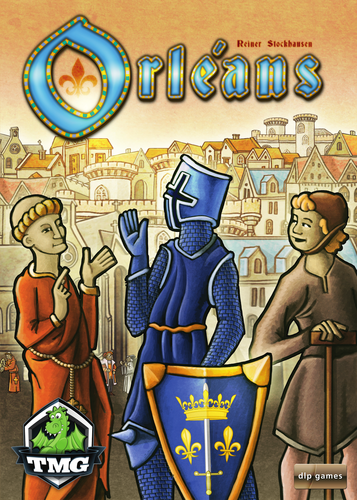
  • Having a middle aged dude staring out from the front of the box is a must.
  • Sticking some camels, sheep or wheat in there as a commodity is an unwritten law

I guess if it ain’t broke, don’t fix it, but they are never going to capture the youth market with such selling points. Still they are pretty awesome things IMO. Low luck, interesting choices and clever mechanics all packed into around 90 mins. They are probably my favorite type of game and in the store we’ve had three crackers hit the shelves recently you may be interested to learn a little about. None of these games are crazily complicated and if you’ve played Catan, Takenoko, Ticket to Ride (lighter Euro games), you are already 2/3’s of the way there. If you want to know more watching Mr. Rahdo wax lyrical about these games on YouTube is a good way to learn the rules and strategic levels available. First up…

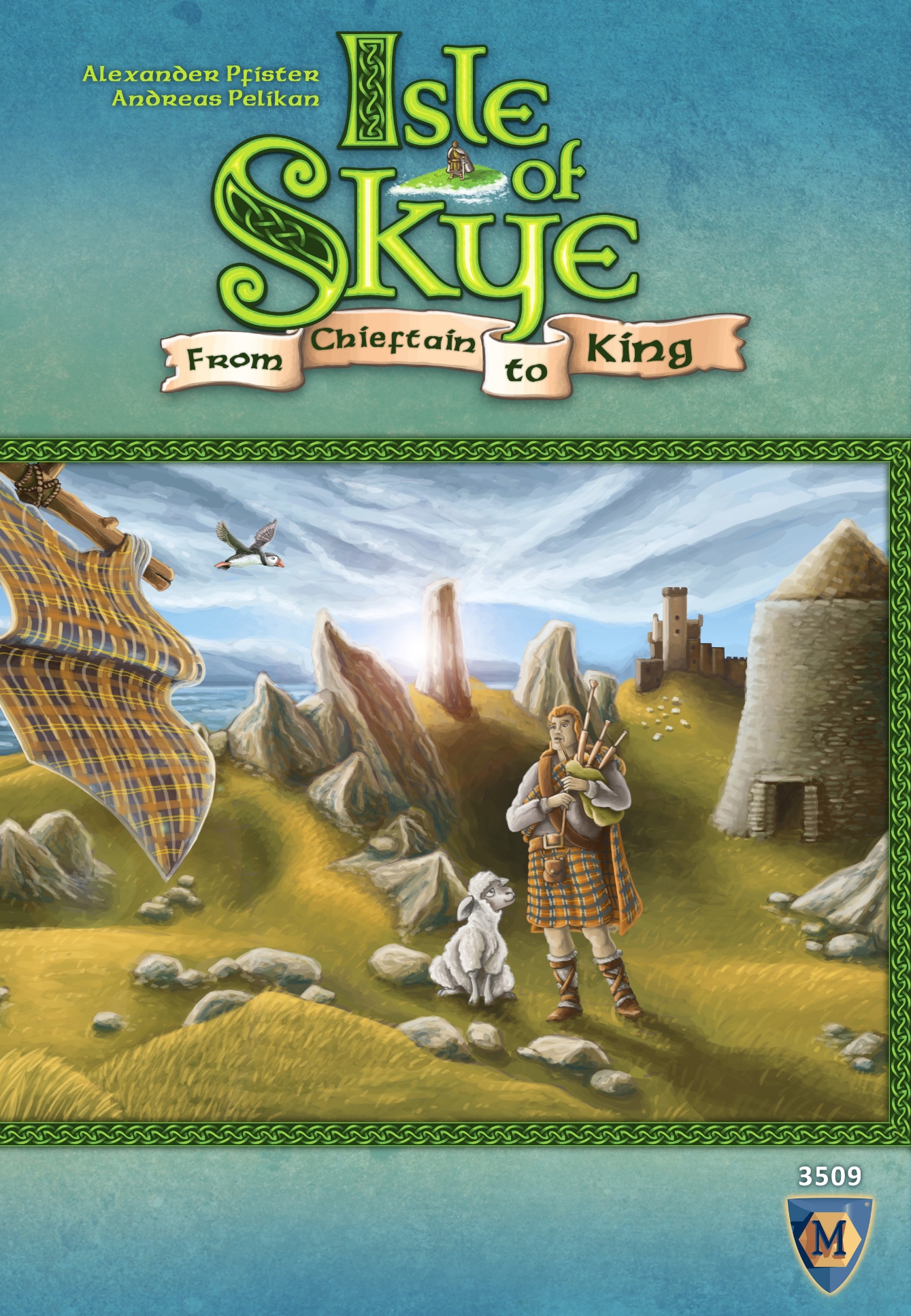
Isle of Skye

isle of sksye
In a Nutshell: It’s Carcassonne with an auction and variable scoring.

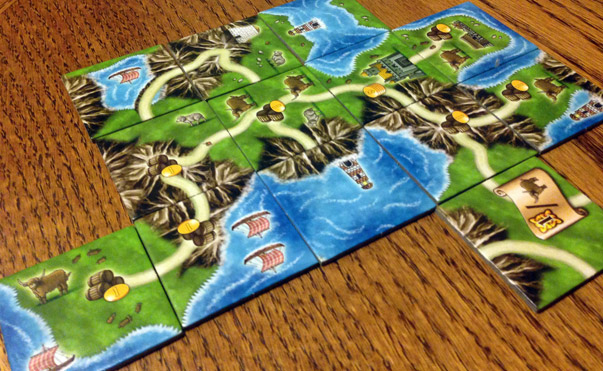
Gameplay: There are 16 different ways to score in this game, however each game you will pick just 4 of them, which will be labelled A, B, C and D. Over the course of 5 or 6 rounds, they will each score 3 times. A and B in the first round, B and C in the second A, C and D in the third etc…

ios carc

A game consists of the following:
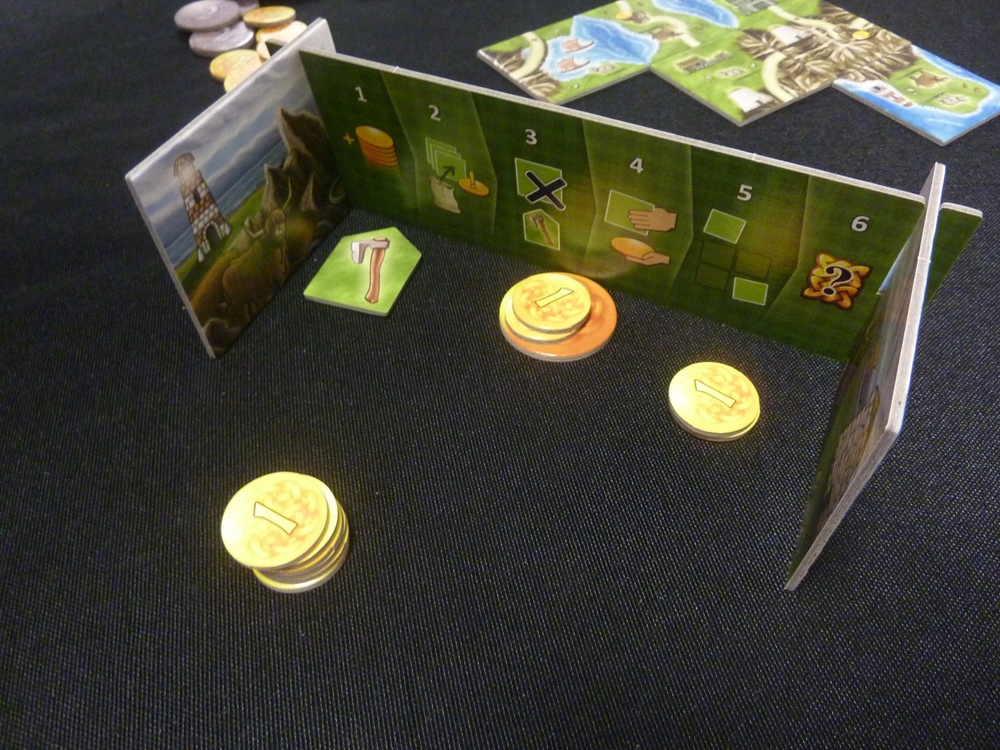
Drawing three tiles from a bag and then pricing them in secret. The tiles can be seen by everyone, but behind a screen you will price two and axe a third which will be tossed from the game. When everyone is ready, you all reveal your pricing and starting with the first player you each get to buy one tile off of anyone except yourself. However, you set the price with your own money, which can’t be used to buy tiles. If someone buys the tile you get that money back and the money they bought it with. Any tiles that were not bought, have to be paid for buy you, so set them too high and you are buying them yourselves. You then all place your tiles Carcassonne like in front of you. Water must connect to water, grass to grass and mountains to mountains. Where you place them and what you buy will be driven by the scoring tiles of that game. You will receive some more money at the start of each round to spend again, but only so much money will leave the game so prices will go up fairly fast.

player screen

Why its awesome?

What price to set is crucial. Sometimes you want your own tile so you set it really high to put people off, but that leaves you poor to buy other peoples tiles. Add in the puzzly nature of the tile laying and the fact every game plays very differently depending on the scoring tiles and you have a really jam packed game in a 45-60 minute time span at a reasonable price point.

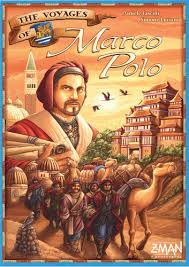
The Voyages of Marco Polo

marco polo

In a Nutshell: Get a crazy power, roll some bones and stick ’em on the board to do stuff.

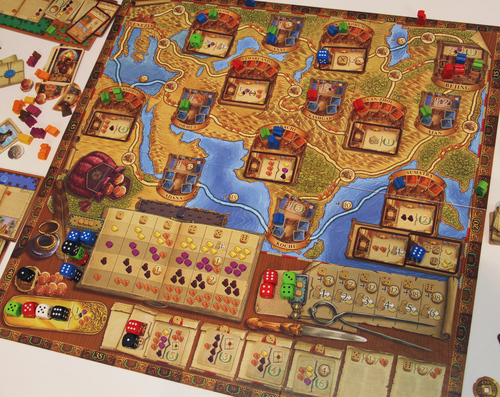
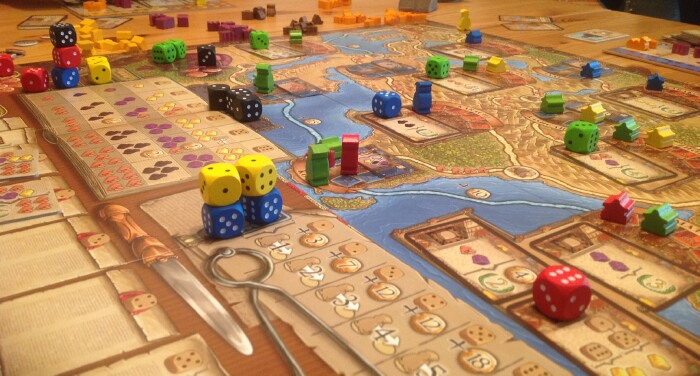
Gameplay: Over 5 rounds you will try to collect resources to fulfill contracts as well as voyage around the map to set up trading posts to expand your options and get more stuff. You do this by rolling 5 dice and then placing them on the board in different spots to do a variety of actions, such as move, get money, convert stuff into other stuff and obviously get camels. Sounds very dull, but its really not!

mp main board

A game consists of the following:

At the start the game you will receive a character with a special power. In many games these are nice but fairly minor in the big scheme of things. In Marco Polo, they are game changing so that your game will be entirely different because of that power. One example would be the ability to not have to roll your dice, just set them to whatever the heck you want. In the game, the first player to get from Venice to Beijing gets a big point bonus. One charactr lets you start already in Beijing, with the full point bonus already with zero competition to get to the local towns and cities as everyone else is on the other side of the globe! It is very cool.

Marco_Polo_review_2

Each round you roll your 5 dice, low rolls get compensation. Then in turn order you start placing them on action spots to gain resources, get contracts and move. When you move you have to pay lots of money, because in those days you couldn’t take a Westjet flight. Where you stop you get to set up shop, this means getting a bonus at the start of every round or earning the ability to do new actions. In most cases you can take the same action that someone else took, but if someone else is already there you have to pay some money. The higher the number on the dice, usually means a better action, but you have to pay the number on the dice to do that action, bummer. During your turn you can pay camels to get another dice, re-roll them or just up them a pip in value. Once everyone has placed all their dice, the round is over and you take them all back. Re-fill contracts and roll again.

Why this game is awesome?

Unlike a lot of worker placement games, where if someone takes a spot its blocked; in this one, in most cases (but not all) you can still go there, you just have to pay to do so. That makes for some really tough decisions, because all the choices are there, but cash flow will limit your choices, not who goes where. Movement is really tough. Its costs a small fortune to get anywhere, so deciding where to go is tough and a lot of your points will be determined by that. Many locations on the board offer an action, but only 9 out of the 30 or so available are used each time, so lots of variability in the map set up. Finally those powers, so powerful, so game defining, but yet balanced and they make each play oh so different.

Orleans

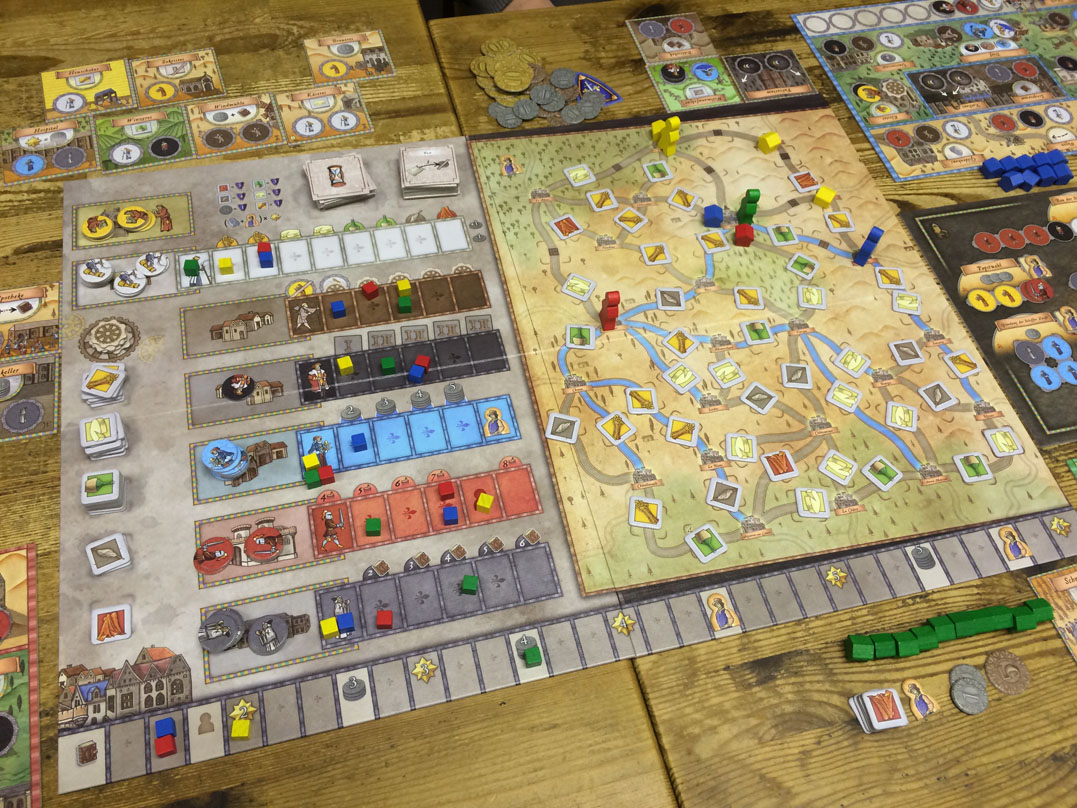
orleans

In a nuthshell: draw guys from a bag, stick ’em on the board to get more guys, which you then throw in the bag. Lather, rinse, repeat…

Gameplay: 17 rounds. At the start of each round an event happens. You draw guys from your bag and then everyone simultaneously places them on their own board to do actions and/or gain workers. When everyone is ready, the start player does one action, putting their guys back in the bag, then the next player and so on until everyone has completed all their actions. Resolve the event and start the round again. You are trying to earn points by collecting resources (wheat is one of them), set up trading houses around Orleans and earn money, all of which translate into points.

Orleans_player_board

A game consists of the following:

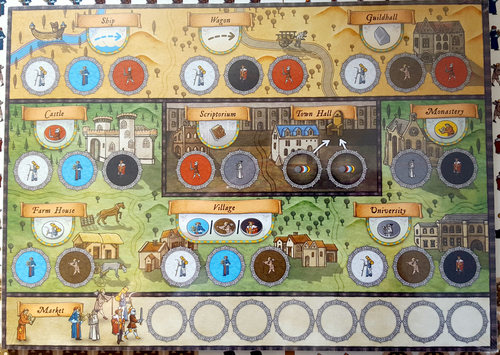
Each player has their own personal board with which they can do stuff. No competing here. You always get to do what you want(ish). An action usually requires 2 or 3 different guys to complete it. When you draw from the bag you may not necessarily get the ones you needed. That’s fine. You don’t have to use all your guys, they can be saved from round to round until you get what you need. There are two major types of action, the moving on the board actions and the getting more guys actions. At the start you need more guys. Depending on the strategy you decide upon, you will need more of certain guys than others. When you obtain a new follower you get to put him in your bag and also receive a bonus by moving up a track of that follower. The further up the track you go, often results in better bonuses. For example gaining a Knight means you can draw more guys from the bag. A monk can be used as a wild card in place of other guys and the craftsman enables you to automate a space on your board, so it is essentially always filled for the rest of the game. A merchant enables you to take a trader tile and add it to your board, expanding the number of actions available to you. The board actions move your pawn around the communal board which depicts a map around Orleans. Doing so enables you to collect goods and as another action place trading stations which are worth points at the end of the game. The last key choice is the ability to send your people to the beneficial deeds board. This is a way to clear unwanted follwers from your bag as they stay there, never to return.

Orléans-Main-board

What makes this game awesome?

As my wife would say, ‘you can’t mess with my stuff!’ It’s a pretty solo game. There is a little bit of a race to be the first to get something in there, but its a pretty minor part of the game. There are tonnes of choices and the bag draw forces you to make the best decision you can with what you get, which may not always be what you want. Everyone makes their major choices at the same time, which is great, so there is very little waiting around for others to take their turn. Finally the choice of strategies available is massive, you can go down a tonne of different routes in order to claim victory and the merchant tiles offer some nice extra options to give you extra options. Plus the bags are made of a very nice, bright velour!

Some more new games to get excited (or not) about…

Imagine – Concept crossed with Gloom, as you use transparent cards to help people figure out the word/phrase you are trying to get them to guess, see here for an overview:

Munchkin Marvel – Its Munchkin plus Marvel. A match made in Heaven? I think so. We may lose half the World’s rain forest trying to make enough copies of this one.

munchmarv

Stone Age Junior – now this is not one that I expected to happen, still its nice that they are focusing a little more on kids games. However, in my humble opinion, the best kids games are the ones that were intended as a kids game from the start, rather than trying to force a known title into something easy for young people.

SA jnr

Legendary: Firefly – per episode, has any show had more impact on Geek culture? This looks fun. If you haven’t tried the Legendary deck building system and like the show, I strongly recommend the game.

fireflyleg

Deadpool Board game – Upper Deck, generally make good games, so I have total faith(ish)…

deadpool.

Agricola: Regular, Family and Deluxe edition – after the current print runs, the game will be getting a make over. Regular base game will be 1-4 players (its 1-5 at the moment) with one set of cards selected from the current 1000+ available, with a 5-6 player expansion available. A cheaper family version without the cards will also be released (pictured). A 10 year anniversary (10 YEARS!!! ALREADY!!) edition with 1000+ cards is also being planned.

agfam

Star Trek-apalooza – Star Trek Panic is first up, followed by Star Trek: Frontiers, a re-skin on Vlaada Chvatil’s Mage Knight.

panic_startrek_3dbt_web_0

Onitamia – Finally,  for the abstract 2 player fans, this little Japanese game looks like an absolute beauty!

onotami

2016’s most anticipated games – some will likely be very rubbish…

Many of these games were funded through Kickstarter which has a spotty record at best. When I look back at last years anticipated games, some came up with the goods (Pandemic Legacy) and other came out of nowhere to knock our socks off with their awesomeness (Codenames). Hopefully 2016 is as good as 2015 was…

Sushi Go Party

SGP

An expanded version of the card game Sushi Go! You still earn points by picking winning sushi combos, but now you can customize each game by choosing à la carte from a menu of more than twenty delectable dishes. Plus up to eight players can now join in.

Knit Wit

KW

It’s by Matt Leacock of Pandemic fame and is a party game, beyond that, this is all I know: you craft your own word categories using loops and spools, then find playful answers that match as many categories as possible. The more categories you match, the more points you score! Who will be quick enough to grab the bonus buttons?

Star Wars Rebellion

SWR

Fantasy Flight’s mega box game of the year. In Rebellion, you control the entire Galactic Empire or the fledgling Rebel Alliance. You must command starships, account for troop movements, and rally systems to your cause. Given the differences between the Empire and Rebel Alliance, each side has different win conditions, and you’ll need to adjust your play style depending on who you represent. It’ll cost a billion dollars to buy, but that has never stopped Star Wars fans before.

Scythe

scythe1

Without doubt, the most eagerly anticipated gamer game on the planet. A huge Kickstarter, incredible art and sky high expectations. I’ll just let the pictures do the talking…

scythe2

Scythe3

scythe4

Secret Hitler

SH

The latest game from the Cards Against Humanity people. A social deduction game in the vein of the Resistance, which is all the rage right now. The game goes as follows : Each player is randomly and secretly assigned to be a liberal or a fascist, and one player is Secret Hitler. The fascists coordinate to sow distrust and install their cold-blooded leader; the liberals must find and stop the Secret Hitler before it’s too late. The liberal team always has a majority. At the beginning of the game, players close their eyes, and the fascists reveal themselves to one another. Secret Hitler keeps his eyes closed, but puts his thumb up so the fascists can see who he is. The fascists learn who Hitler is, but Hitler doesn’t know who his fellow fascists are, and the liberals don’t know who anyone is. Each round, players elect a President and a Chancellor who will work together to enact a law from a random deck. If the government passes a fascist law, players must try to figure out if they were betrayed or simply unlucky. Secret Hitler also features government powers that come into play as fascism advances. The fascists will use those powers to create chaos unless liberals can pull the nation back from the brink of war. The objective of the liberal team is to pass five liberal policies or assassinate Secret Hitler. The objective of the fascist team is to pass six fascist policies or elect Secret Hitler chancellor after three fascist policies have passed.

Spinderella

Spind

Winner of last years Kids game of the year, it uses magnets in a very cool way as you move across the board trying to avoid a Spiders clutches

Fog of Love

FOL

A card game for two players who act out a stormy love affair. You play from the very first sparks of attraction through in-law encounters, awkward situations, arguments, parties, thoughtful gifts, secret affairs, kids, and reconciliations to a hopefully happy ending. Each player has a character made up from different personality traits that influence what they desire and want to avoid. You can become a one-legged, disorganized, cocky female pilot who gets a kick out of adventures; a kind, nerdy male tv celebrity who is ambitious and sensual; or a cute, flirtatious, impulsive and cynical female florist with a big nose-piercing. The possibilities are almost endless. Will the characters end up in a satisfying relationship and get married — or will it all end in a dramatic break-up? You learn what it takes to make the relationship work, build insights into each other, and hopefully find out whether your partner is sincere or just bluffing. Each player alternately introduces crucial scenes with important choices to be made. As in real life, you have to decide between what is best for you and what is best for the relationship – and you need to consider what your partner decides as both of your decisions will have impact on the shared outcome.

The 7th Continent

7th cont

Another massive Kickstarter, financially and in game time, with one game lasting up to 100’s of hours (it has a save system). A solo or cooperative “choose-your-own-adventure” exploration board game, you choose a character and begin your adventure on your own or with a team of other explorers. Inspired by the Fighting Fantasy book series, you will discover the extent of this wild new land through a variety of terrain and event cards. In a land fraught with danger and wonders, you have to use every ounce of wit and cunning to survive, crafting tools, weapons and shelter to ensure your survival.